

The Old Guard
A new academic finding says the safest jobs for a long career are getting riskier for the workers who held that safety longest. The instinctive explanation is that older workers won’t learn the tool.

Start with the finding, because it is more specific than the discourse around it. In June, the Center for Retirement Research at Boston College published an analysis of what happens to workers 55 and older whose jobs are heavily exposed to generative AI. Before ChatGPT launched, those workers had an advantage: jobs with high AI exposure tend to require more education, less physical labor, and pay more, and workers in them left employment at a lower rate than their peers in less-exposed jobs, 11.7% versus 14.1%. That was true controlling for race, education, earnings, and industry. High AI exposure, in other words, used to be a marker of career durability.
Since ChatGPT, that advantage has been eroding, specifically through a rise in exits to unemployment, not voluntary retirement. The researcher’s model puts numbers on it: a computer programmer’s predicted rate of leaving work rises from 8.7% to 11.1%, a relative increase of more than 25%. A painter, in a low-exposure job, moves from 13.5% to 13.7%, barely at all. The jobs that used to protect long careers are the ones now showing the sharpest relative cost.
Read that finding next to a headline and the story writes itself: older workers, resistant to new technology, are getting pushed out by the AI they refused to learn. It is a tidy story. It is also not what the other data says.
What the data actually shows
AARP has run the same survey of workers 50 and older three times now, most recently in March 2026. Two things have moved a lot. Familiarity with AI has climbed from 39% to 52% over three waves. Actual use at work has climbed from 14% to 23%. Interest in learning more has stayed almost perfectly flat the entire time: 48%, 47%, 49%. Roughly half of workers 50-plus have said, in every wave, that they want to learn more about using AI in their work.
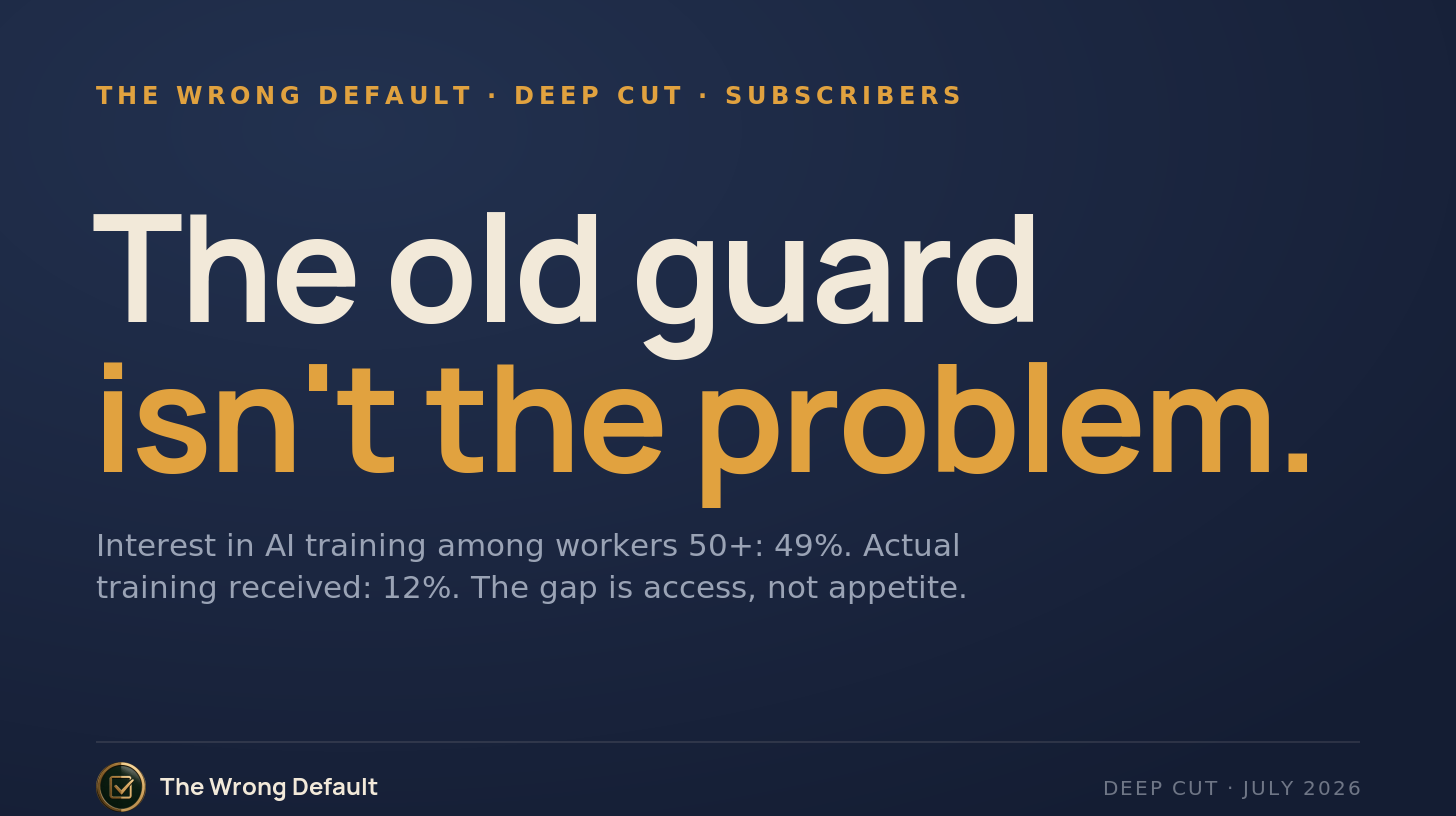
One thing has not moved with any of that. Only 12% of workers 50-plus report having taken any training or classes on using AI for work, up from 10% the wave before and 7% the wave before that. Interest sits at 49%. Training sits at 12%. That is a 37-point gap, and it has not closed as familiarity and usage both rose around it.
The workers surveyed have an explanation, and it is not about themselves. Sixty-three percent say their employer is not doing enough to train workers to use AI. Sixty-six percent say their employer does not offer AI training to all workers regardless of age. These are not workers describing their own reluctance. They are describing a program that is not reaching them.
The gap is access, not appetite
Put the two data sets together and the story changes shape. The workers in the highest-exposure, highest-paying, most tenured half of the workforce, the ones the CRR analysis found are now losing a career advantage they used to hold, are also the workers least likely to have been trained on the tool reshaping their jobs, despite wanting to be. The gap is access, not appetite.
This is not a story about an individual choice made badly. It is a story about where training budgets and rollout plans default to when nobody decides otherwise. Onboarding tracks are built for new hires. Pilot programs recruit early adopters, who skew younger by the nature of who volunteers first. Change-management budgets get allocated to the parts of the org with the most headcount growth, which is rarely the most senior cohort. No one convenes a meeting to exclude the tenured half of the workforce from the AI rollout. The rollout simply gets built, by default, to reach everyone else first, and the org reads the resulting low usage among senior staff as reluctance rather than as an artifact of where the training went.
That reading has a cost, and the CRR analysis is measuring it. It is exactly the senior, high-exposure, high-tenure workers, the ones with the most formed judgment and the least training on the tool now doing part of their job’s work, who are showing up in the unemployment numbers.
The flattering version, because it is also the true one
Here is the part usually missing from this conversation. A worker with decades of formed judgment, paired with the cheapest capability multiplier currently on the market, is not a liability case. It is the strongest combination available to any employer right now, stronger than the junior worker who has the tool but not yet the judgment to know when its output is wrong. The senior employee who gets access to the training is not being rescued. They are being handed the tool that makes their most valuable asset, judgment formed over a career, compound instead of depreciating.
That is the opportunity sitting on the other side of the 37-point gap. It is not a smaller version of the junior AI rollout. It may be the highest-return version of it, because it is the only one pairing the tool with judgment that already exists.
What this is and isn’t
This is not an argument that older workers are uniformly eager or that every senior employee wants to learn a new tool. Some don’t, the same as some workers of every age don’t. It is an argument that the aggregate data does not support treating low AI usage among the most tenured half of the workforce as a story about their reluctance, when the same workers report wanting the training at nearly the same rate as anyone else and simply are not getting it.
The wrong default here is quiet and unowned, the same shape as every other one this newsletter tracks. Nobody decided that senior staff would be trained last. Training pipelines were built to solve other problems, onboarding, pilot recruitment, headcount growth, and the tenured half of the workforce fell outside all three by default, not by design. The cost of that default is now visible in a Boston College labor economist’s regression tables, showing up as unemployment, not retirement, in exactly the jobs that used to be safest.
Since the gap is access, not appetite, closing it is not a diversity gesture or a retention perk. It is the cheapest, highest-return AI investment most organizations have not made, sitting in plain sight, already in a training budget that was never built to reach the people who most consistently say they want it.
Sources for every figure cited (AARP Research Wave 3, the Center for Retirement Research Boston College Issue in Brief 26-13) are listed below, each pulled from the primary publication.
Fellowship Intelligence helps organizations govern the decisions AI is already making. Learn more at fellowshipintelligence.com.
Sources
1. Center for Retirement Research at Boston College, Issue in Brief 26-13, “Are the Careers of Older Workers Being Cut Short by AI?” (June 2026), by Geoffrey T. Sanzenbacher. Combines Current Population Survey data (2014-2026, via IPUMS) with the Digital Planet Initiative’s (Tufts University) AI Exposure Index. Pre-ChatGPT, workers 55+ in above-median AI-exposure jobs exited employment at 11.7% versus 14.1% for below-median, controlling for demographics and job characteristics. Post-ChatGPT, AI-exposed jobs saw a relative increase in total exit, specifically to unemployment (not out-of-labor-force or retirement). Predicted-probability example: computer programmers rise from 8.7% (pre) to 11.1% (post) predicted non-employment, versus painters moving from 13.5% to 13.7%. Full PDF · Landing page. Verified 2026-07-23.
2. AARP Research, “AI is Impacting the Future of Work Among Adults Age 50-Plus,” by Rebecca Perron, Wave 3, updated May 11, 2026. Methodology: interviews conducted March 12-16, 2026, among 1,015 U.S. adults 50+ in the labor force (Foresight 50+ Omnibus, NORC), weighted to be nationally representative. Key figures: 53% say they’re knowledgeable about AI generally (Wave 1: 48%, Wave 2: 52%); workplace familiarity 39% (W1) to 45% (W2) to 52% (W3); 23% use AI to a great/some extent at work (W1: 14%, W2: 16%); only 12% report having taken AI training or classes (W1: 7%, W2: 10%); 49% interested in learning more (W1: 48%, W2: 47%), a 37-point gap between interest and training in Wave 3; 35% agree their employer is doing enough to train workers on AI, 63% disagree; 31% say their employer offers AI training to all workers regardless of age, 66% disagree; 24% see AI as a threat today, 19% as an opportunity, 37% both. AARP page · Suggested citation: Perron, Rebecca. How AI is Impacting the Future of Work Among Adults Age 50-Plus. Washington, DC: AARP Research, August 2024, updated May 2026. DOI: 10.26419/res.00848.001. Verified 2026-07-23.