
Sold on Both Sides
Opinion. The AI-detection business and the AI-cleanup business are the same business. The only real judge was always the reader.

Two people I follow reported the same kind of thing this month. Their writing had been flagged as AI-generated, and a vendor was ready to sell them the cure: a service to make their writing sound less like a machine. The detail that should stop you is what got flagged. In both cases it was work they wrote for college, twenty-five to thirty years before a language model could produce a fluent sentence.
Sit with that. A tool sold on its ability to detect AI writing looked at plainly human writing, written before the category existed, and called it synthetic. Then a second tool stood ready to sell the fix.
A non-issue, sold on both sides
This is a two-sided market built on a problem that does not exist where the vendors say it does. One side sells structure: templates and recipes to format your writing so machines parse it, summarize it, and cite it. More formatted posts, published faster, surfaced by more systems, is more traffic and more revenue for the platform selling the recipe. The other side sells suspicion: detectors that score your writing for machine-ness, and a cleanup service to lower the score. Fear on the way in, a fix on the way out.
Neither side is selling you better writing. One is selling volume. The other is selling relief from the anxiety the volume created. The person caught in the middle is the one who actually did the work, now paying, in stress or in dollars, to prove a negative to a machine that was wrong.
The detector argues against itself
A detector that flags thirty-year-old human writing is not detecting AI. It is detecting a register: clean, structured, declarative prose, the kind careful writers have always produced and the kind good editing moves toward. Call that synthetic and you have not built a lie detector. You have built a style penalty, and the people it penalizes hardest are the ones who write clearly.
The cleanup service completes the circle. Its job is to make writing look less like that. Strip the structure, rough up the cadence, write a little worse, so a flawed classifier waves you through. We have arrived at a product whose function is to help people write less like themselves in order to satisfy a tool that was mistaken in the first place.
The fix that fixes nothing
Run the same service on the case it was ostensibly built for, genuinely low-effort AI output, and it does not help either. It makes weak, unexamined content more convincing. It does not make it understood, least of all by the person whose name is on it. You end up with writing that reads as human and authoritative, produced by someone who still could not tell you why any of it is true. That is not a fix. That is the actual problem, dressed better.
Where the problem actually lives
The thing all of this is trying to automate away is judgment, and it sits in exactly one place: the reader. Is this true. Is it any good. Do I agree. Those questions were never answerable by a score, because reading something and deciding what you think of it is work, and a number is easy. The detection-and-cleanup economy exists to sell an escape from that work, on both ends, to writers who want a clean bill of health and to readers who would rather outsource their verdict than form one.
You cannot outsource it. A score cannot tell you whether an argument holds. It can only tell you whether the prose pattern-matches to a training set, which is a different question, and increasingly not even a useful proxy for the first one.
Why I am bothering to write this
This is not a defense of slop. No, you should not generate a pile of confident text you do not understand and put your name on it to sound smart. That is the real failure, and it predates AI by centuries. The tool did not invent the poser. It just lowered the cost of getting to the starting line, so there are more of them, faster.
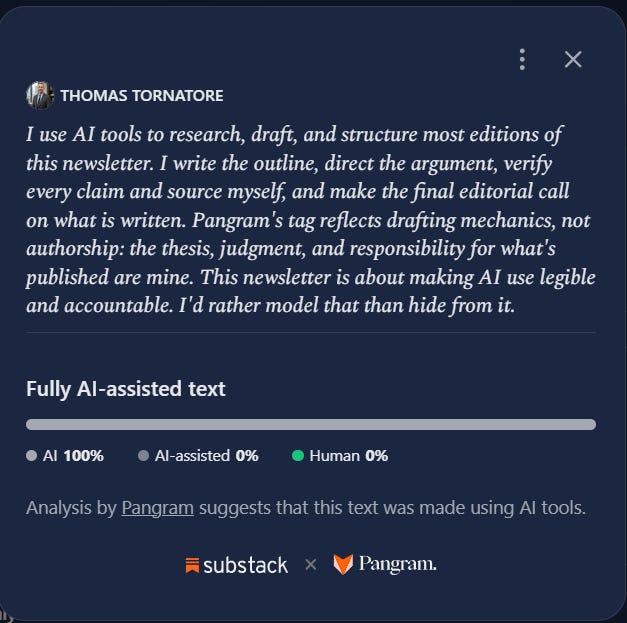
But it is also not true that using AI to help you write means you do not know what you are talking about, or that the work is worthless. I use it to stop staring at a blank page and to test my theories out loud before you have to read them. I also choose the topic, make the argument, and check every fact I state as true. The tool did not hand me the judgment. I brought an entire lifetime of making my own decisions with me. The line that separates real work from the wasted text was never the tool. It was, and remains, whether a person with a true understanding of a topic chose to share their knowledge and stood behind the words.
The wrong default here is the quiet one, wearing the same shape as every other one this newsletter tracks. Nobody decided that writing would be judged by a machine’s guess about how it was made rather than by whether it is right. We allow the tools to fill the vacuum, because judging the machine is cheap and judging the work is not. The cost of that default lands on the person who did the work, and the revenue lands with whoever is selling the score, and the service to beat it.
So before relying on a score decide for yourself. That was always the job, on both sides of the screen.
Fellowship Intelligence helps organizations govern the decisions AI is already making. Learn more at fellowshipintelligence.com.